
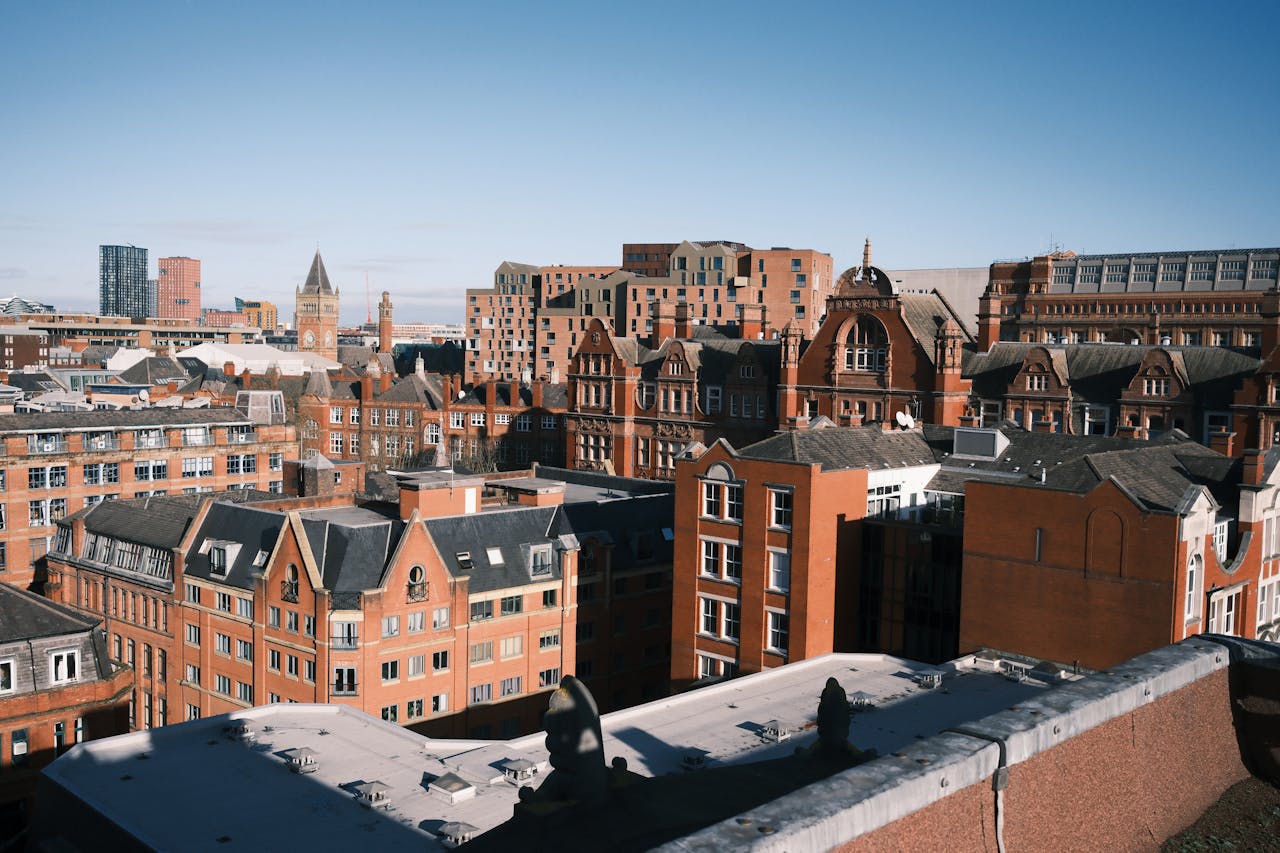
Didsbury behaves nothing like Ancoats. Salford nothing like Stretford. A look at how Manchester’s neighbourhoods are actually performing this year, postcode by postcode.
One city, at least a dozen markets
Manchester has had one of the fastest-changing property markets of any UK city this decade. City-centre apartment growth, surging South Manchester family demand, the rise of MediaCity and Salford Quays, and a quiet renaissance across the East and North have reshaped what moving here means. In 2026, the city has at least a dozen property markets, each with its own buyer profile, time-on-market and price path. For anyone thinking about a move, the data tells a more useful story than the headline numbers.
Where the city sits right now
ONS figures put the average Manchester house price at around £251,000 in early 2026, up roughly 3.9 per cent year-on-year. Greater Manchester’s tech sector now employs more than 88,000 people across over 10,000 businesses and contributes more than £5bn to the regional economy, sustaining professional buyer demand. City-centre and Salford Quays apartment supply has accelerated, with Build-to-Rent developers expanding their footprint, while family-led South Manchester and Trafford postcodes have stayed consistently in demand. People relocating from London continue to arrive, drawn by lifestyle, relative affordability and the tech and creative economy.
For Mancunians weighing up a move, the data is making those differences clearer. GetAgent has spent the past decade tracking how individual estate agents actually perform rather than how loudly they market themselves, and applies that lens to Manchester estate agents, cross-referencing live and sold figures from Rightmove, Zoopla, OnTheMarket and the Land Registry. The London-founded platform, which launched in 2015 and now works with more than 7,000 partner agents and over a million UK homeowners, reads the city unambiguously: Manchester’s neighbourhoods do not all behave the same way on the property market.
A walk around the neighbourhoods
The city centre, taking in the Northern Quarter, Ancoats, Castlefield and Spinningfields, is the reinvented urban core, and Ancoats has been the standout story of the past decade, mixing new-builds, converted mills and independent food and drink, with demand from professionals, downsizers and Build-to-Rent tenants. Didsbury remains the most consistent family-buyer favourite, leafy and period-led with strong schools and Burton Road cafe culture, where family homes sell quickly when accurately priced. Chorlton is bohemian and family-friendly with a creative and academic buyer base and a deep community feel. Withington and Burnage draw buyers priced out of the central postcodes. Heaton Moor and Heaton Mersey, Stockport-adjacent and family-led, offer larger period homes, strong schools and good rail links to Piccadilly. Levenshulme, east of Didsbury, has been dramatically reshaped, with period stock, food-market culture and growing first-time-buyer activity.
Salford Quays and MediaCity bring modern waterfront living and the BBC and ITV creative footprint, with demand from media professionals, downsizers and Build-to-Rent tenants, while Salford proper, Ordsall, Pendleton and Eccles, mix period terraces, regeneration sites and growing buyer interest. Sale, Altrincham and Hale form an affluent Trafford commuter belt with Metrolink connectivity and excellent schools. Stretford and Old Trafford offer period terraces and strong community character, popular with younger families priced out of Chorlton. Whalley Range is leafy, eclectic and period-led with quietly strong family demand. Prestwich and Whitefield to the north, and Cheetham Hill and Crumpsall closer in, each carry their own mix of family, first-time-buyer and investor interest.
What the data shows
Well-presented period terraces and family homes with outdoor space sell fastest across most South Manchester postcodes, and accurately pitched listings outperform over-priced ones. Buyer profiles vary sharply, the city centre and MediaCity tilting toward professionals, Didsbury, Chorlton and Heaton Moor toward families, Levenshulme, Withington and Stretford toward first-time buyers, and Hale and Altrincham toward established families. Outdoor space remains a top filter even in compact city-centre flats, Metrolink and rail proximity keep pushing demand toward well-connected postcodes, and EPC rating increasingly affects time-on-market for older stock.
What the numbers reveal
Speaking to the figures, Peter Thum-Bonanno, Co-Founder and CTO of GetAgent, said: “Manchester is one of the most striking UK examples of how varied a ‘single’ market actually is. Postcode-level data tells a far richer story than city averages. What stands out is how consistently family-led South Manchester and Trafford postcodes hold demand, while city-centre apartment markets move more visibly with rate sentiment and Build-to-Rent activity.”
He added that the quickest sales follow a pattern. “The fastest sales in Manchester share three features: accurate first pricing, strong presentation and outdoor space, regardless of price point. Anyone tracking Manchester property in 2026 should be looking at postcode-level patterns rather than headline averages, because the variance within Greater Manchester is significant.”
What Manchester buyers want now
Outdoor space is the most filtered feature across Manchester property searches. Period character, particularly Victorian and Edwardian terraces, carries weight in Didsbury, Chorlton, Withington, Whalley Range and Heaton Moor. Metrolink and station proximity measurably affect time-on-market and price, and school catchments drive premium demand in Didsbury, Chorlton, Sale, Altrincham and Heaton Moor. Modern kitchens, bathrooms and energy efficiency matter more than they did; parking is increasingly important across South Manchester and Trafford, and EPC is a bigger factor than five years ago.
A few pointers before you move
If you are thinking of moving, a few things help. Visit at different times, the school run, a weekend, an evening, to get a feel for the area. Walk to the nearest tram stop, cafe, park and supermarket from anywhere you are considering. Speak to local agents who actually live in the city, not just sell in it. Check school catchment maps if that matters to you. Compare agent performance on sale-price achieved, time-on-market and withdrawal rates, and don’t underestimate the outer postcodes, where Stretford, Levenshulme, Burnage and Prestwich often offer more space for the price.
Find your part of the city
Manchester has rarely been more interesting as a place to live, and the city’s variety is finally catching up with its reputation. The 2026 data shows clearly that what works in M1 may not apply two stops out, and what holds in Didsbury may not apply in Salford. For anyone thinking about a move, the most valuable thing is no longer general property news, but specific, postcode-level data and a feel for the neighbourhoods themselves. The best place to live in Manchester isn’t the same for everyone, but with the right data and a few good walks, you’ll find your part of the city.