
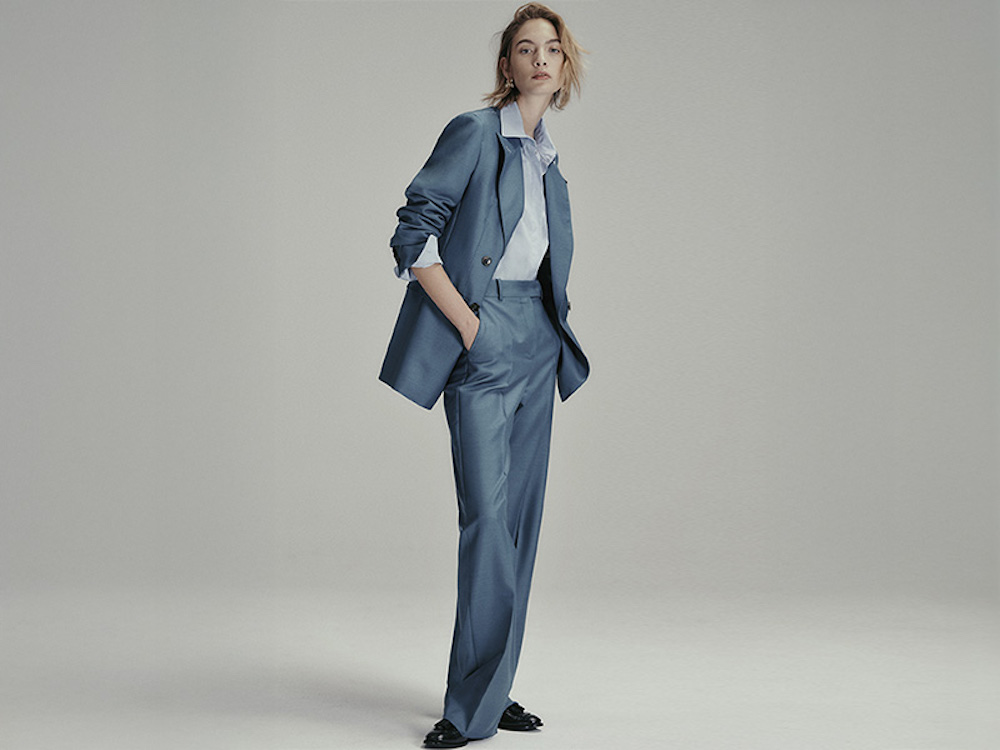
Not every shift in fashion is loud. Some changes settle quietly, shaping new habits without demanding attention. The renewed allure of women’s tailored suits belongs to this kind of movement – calm, deliberate and rooted in the way many women now choose to present themselves.
At a time when wardrobes often feel fragmented, the suit offers a sense of visual clarity. Its appeal lies in the precision of its lines and in the quiet strength it conveys, a combination that feels distinctly modern.
Modern silhouettes: precision softened by movement
Today’s tailored suits stand apart for the way they balance definition with ease. The construction is thoughtful, yet the result never feels rigid. Jackets follow the line of the torso without constriction, and trousers create a vertical gesture that lengthens without tightening.
What makes these silhouettes compelling is the way they frame the body while allowing it to move freely. The suit introduces order, not constraint. It sharpens the outline just enough to create presence, but it stops before becoming assertive. This new approach to tailoring reflects a sensibility that values control without strictness – a modern discipline expressed through proportion and restraint.
A refined expression of strength
The suit has always carried an idea of strength, but that impression has changed. Today, strength dresses differently. It no longer relies on exaggeration or sharp contrasts. Instead, it appears in gestures that are measured and composed. In a women’s tailored suit, the sense of authority does not come from volume or severity: it comes from coherence.
This quiet confidence is what gives the suit its renewed relevance. It forms a kind of visual punctuation – clear, clean and deliberate. It doesn’t rely on borrowed codes or theatrical silhouettes. Its purpose is not to dominate but to clarify, to bring a sense of stability to the overall look.
The importance of material: texture as modern language
One of the most compelling aspects of contemporary tailoring lies in the feel of the fabrics. Materials shape the mood of a suit long before colour or cut. Wool blends with a soft hand, compact crepe that falls with precision, double-faced textiles that maintain structure while remaining light – each fabric alters the character of the suit in a subtle way.
Texture plays a central role. It influences how the jacket settles on the shoulders, how the trousers move, how the entire ensemble reads in motion. These tactile qualities are essential to the modern suit: they add depth without decoration and make the garment both intelligent and instinctive to wear.
Styling with intention: proportion over contrast
The contemporary approach to styling women’s tailored suits focuses on refinement rather than contrast. Instead of pairing tailoring with deliberately disruptive elements, the emphasis is on materials and layers that maintain coherence. Fine knitwear, soft blouses, lightweight shirts and silk scarves add subtle variation without altering the underlying silhouette.
This way of dressing underscores the suit’s architectural nature. Every element contributes to the sense of proportion – the curve of a lapel, the line of a trouser crease, the softness of a scarf at the collar. Accessories take on a restrained role: belts that define, jewellery that complements, colours that remain grounded.
Why women’s tailored suits feel relevant again
The renewed interest in women’s tailored suits is not about returning to old dress codes. It reflects a broader search for structure in a visually complex world. The suit offers a rare balance: it brings order without strictness and expression without excess. Its modern lines introduce calm. Its subtle strength adds definition.
Women are choosing suits again not because they promise versatility, but because they provide coherence. They offer a way of dressing that is thoughtful, confident and clear – qualities that resonate deeply today. In this renewed allure lies the essence of contemporary tailoring: attire that supports, refines and quietly reinforces the identity of the wearer.
Precision, balance and intention: Max Mara’s approach to tailoring
Every meaningful design begins with a question: how should a garment support the life of the woman who wears it? At Max Mara, this question has shaped decades of activity, guiding a philosophy rooted in clarity rather than excess.
The Maison approaches structure as a form of expression – a way to articulate presence through proportion, balance and an elevated simplicity that feels relevant across time. Tailoring becomes not a uniform, but a framework through which elegance can take shape.
The women who favour Max Mara understand the value of this approach. They look for garments that reflect their intelligence and independence, pieces that integrate into the rhythm of their days while maintaining a quiet sense of authority.
Their style does not rely on overt statements. Instead, it reveals itself through coherence – the interplay of clean lines, refined materials and silhouettes designed to support movement and identity in equal measure.
This sensibility is reinforced within the brand’s broader vocabulary of crafted design. Alongside its iconic outerwear, Max Mara extends its architectural thinking into formal dressing, creating suits that embody the Maison’s signature equilibrium: defined yet fluid, polished yet understated.
Within this landscape, the Tailored Suit Project stands as a testament to the brand’s pursuit of excellence. Each jacket is engineered around an internal canvas, shaped through meticulous hand-finishing and constructed from carefully sourced materials. The process – requiring over 345 minutes of dedicated work – ensures a silhouette that is both classically grounded and distinctly modern, reinterpreted to honour the nuances of the female form. In its disciplined construction, the project encapsulates Max Mara’s belief that true precision serves the woman, never overshadows her.
Through this thoughtful approach to tailoring, Max Mara continues to articulate a definition of elegance that is purposeful, enduring and profoundly attuned to contemporary life.
Image Source: Max Mara