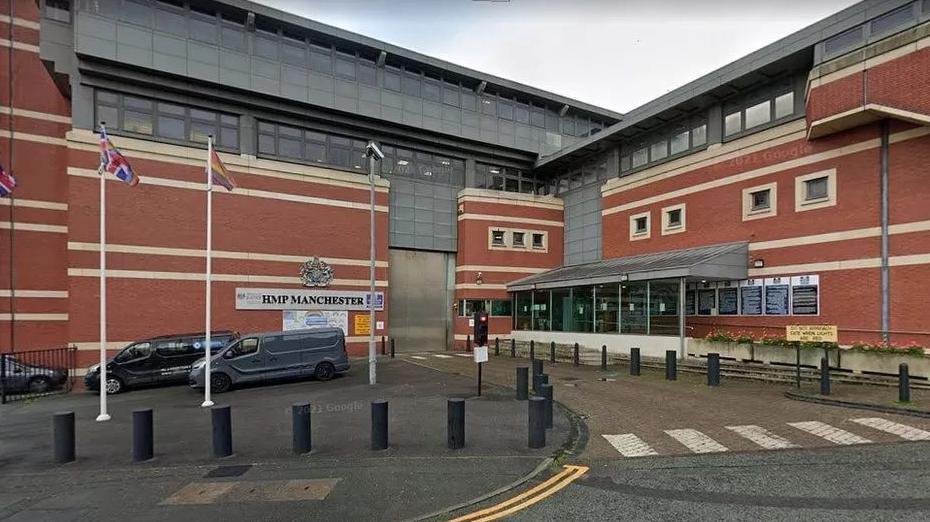
A prisoner being held on remand at HMP Manchester hanged himself just hours after a prison officer falsified his cell check records
Mr Patryk Jalocha died after being found hanged in his cell on 5 November 2024 at HMP Manchester. He was 24 years old and was the sixth apparently self-inflicted death in three years at Manchester
He has been arrested earlier that summer over possession of an offensive weapon and possession of cocaine and bailed pending sentence.
On 5 August, Mr Jalocha was arrested and charged with attempted murder, possession of a firearm and aggravated burglary.
He was remanded to HMP Birmingham. It was his first time in prison. Mr Jalocha told a nurse during an initial health assessment that he was physically well and had no history of mental illness or substance misuse.
He strongly denied any thoughts of suicide and self-harm.
The following day he was identified as a potential category A prisoner (indicating he presented a high risk to the public) due to the nature of his offences and was transferred to HMP Manchester, a high security prison, where hewas given a cell on the landing used for younger and more vulnerable category A prisoners away from the main category A wing.
On 5 September, Mr Jalocha was sentenced to eight months imprisonment for possessing a firearm and six months imprisonment for the charges relating to the incident earlier that summer. Both sentences were to be served concurrently.
He remained on remand for attempted murder and aggravated burglary.
Four days later he was deemed a person of interest to Foreign National Offender Returns Command (FNORC – the branch of Home Office Immigration Enforcementthat deals with foreign national offenders) as the nature of his outstanding offences meant it was likely, if found guilty, that he would be sentenced to more than 12 months in prison and would therefore be liable for deportation after serving all or part of his sentence.
On 20 September, an officer gave Mr Jalocha a notice of liability to deportation issued by FNORC. Mr Jalocha refused to sign to confirm receipt of this until he had spoken to his solicitor.
On 29 September, an officer started Prison Service suicide and self-harm monitoring procedures (known as ACCT) after she noticed that Mr Jalocha had
become withdrawn and spent most of his time in his cell asleep.
Staff stopped ACCT monitoring on 15 October but re-started this on 26 October when officers noticed superficial scratches on Mr Jalocha’s arm and that he had again become withdrawn.
The ACCT case coordinator made some progress towards Mr Jalocha receiving education, obtaining a cleaning job and being allowed access to the main category A unit gym.
On 4 and 5 November, two different members of staff noticed graffiti in Mr Jalocha’s cell but did not examine it or question him about it. The graffiti included a drawing of a man hanging.
At about 10.55pm on 5 November, an officer discovered Mr Jalocha hanged in his cell. Prison and healthcare staff attended and began cardiopulmonary resuscitation (CPR). Ambulance paramedics also attended but declared life extinct just under an hour later
In his report the Prisons Ombudsman found thatThe night patrol officer did not complete the required ACCT checks immediately before Mr Jalocha was discovered hanging and falsified the ACCT record to say he had done so.
The night patrol officer did not radio a code blue emergency when he discovered Mr Jalocha hanging. However, the emergency response was otherwise swift and efficient.
Mr Jalocha wrote a number of things on the walls of his cell that should have been explored with him before he died.
The prison has brought in a number of measures since Mr Jalocha’s death and as a result of an urgent notification from HM Inspector of Prisons (HMIP) in October 2024 to improve ACCT monitoring and increase the number of trained ACCT assessors. As part of this the prison safety team has produced a directory for ACCT case coordinators signposting sources of support for a number of different issues.
This is good practice. In April, the prison implemented a system of random CCTV monitoring to ensure staff complete required ACCT checks.