

When Pliny lost his life and Herculaneum was buried. Manchester was born.When lava and ash blotted from site and memories, fair and luxurious Roman cities close to the capital, the Roman soldiery of Titus under the their general Agricola, laid the foundations of a distant city, which now competes with the great cities of the world.
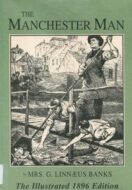
The opening lines from Manchester Man by Mrs G Linnaeus Banks published in 1874,and although the Roman fort in Manchester was founded in AD79, Roman involvement in the area goes back much further in the annals.
The Romans had first landed in Britain over a century before in in both 55 and 54 BC, when Julius Caesar had invaded Britain with the aim of conquest. But revolt in Gaul had drawn him away and it would be another century before the legions would arrive in the North Of England
in 43 AD, with a new emperor Claudius on the throne, 40,000 professional soldiers, half citizen-legionaries, half auxiliaries recruited on the wilder fringes of the empire – were landed in Britain under the command of Aulus Plautius
For a time they remained in the south of the country, happy to let the northern tribes continue to rule unhindered using the Celtic Briganti tribe as a buffer state
The North indeed only gets tow mentions in those early Roman annals.
The Roman Historian Tacticus mentions two previous occasions when the legions came this way,firstly in Ad 48 when Ostorius Scapula the 2nd governor of the Roman province launched a campaign against the Deceangli who were based in modern Flintshire.It is speculated that his troops probably got as far as the Dee estuary when the Brigante legions and the prospect of unsettling a shaky alliance sent him back.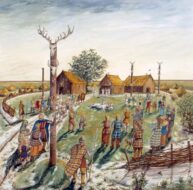
Twelve years later Suetonius Paulinus initiated the same strategy attacking the island of Anglesey though his successes were somewhat negated by the Boudican revolt in the south
But the collapse of the Buffer zone in the AD60’s would bring about the permanent occupation of the North West and lead to the founding of Manchester.
Mystery surrounds the tribe known as the Brigante that inhabited much of Northern England.They were likely a federation of smaller states, once independent but at some time uniting under a single tribal banner.
The Romans had first become aware of the tribe soon after AD43 when the Roman legions reached the Fosse way under the command of Plautius and much of what we know about them comes from Ptolemy’s Geographia Book II Chapter 2 which gave the ancient names of a number of rivers and other geographical features within the territories of the Brigantes tribe.
It was a revolt within the tribe that would eventually force the Romans north and it was a Queen called Cartimandua who would be at the centre of it
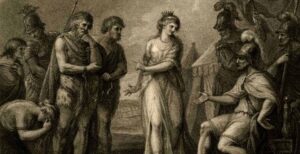 is one of only two British women to be mentioned in the ancient sources, the other being Boudicca and whilst the latter has become a legendary role model for Britain, because of her leadership of the rebellion against the Roman occupation in the South, her northern equivalent has been shunned by history perhaps because unlike Boudicca she welcomed the “good life” offered by the Roman regime.
Married to Venutius, who was, for all intents and purposes, no more than a prince consort, she would establish formal alliances with the Romans who recognised that it was her who was the power behind the throne.
In AD 69 divorced her husband and took another warrior Vellocatus as her partner, an action which prompted a civil war among the tribe
Venutius, who had previously fought for the Romans, turned to the anti-Roman faction among the Brigantes for support and ignited a civil war. The war continued for some time among the Brigantes until Venutius was on the eve of victory.
With Cartimandua in a compromised position, the Romans intervened to save their ally Roman intervention saved Cartimandua but in the end her actions gave the Romans an excuse to conquer Brigantia.
The Romans could not tolerate the long Brigantian border in the hands of a hostile king who could not only attack the south himself but also harbor Roman enemies from the south
By the AD60’s there is much evidence of Roman penetration around the Pennines.A site at Templeborough near Rotherham has been dated to that time by the finding of good quality samian ware from the reign of the Emperor Nero
Historians speculate that site would have controlled the eastern access to the Pennines and it is unlikely that it would have been built in isolation.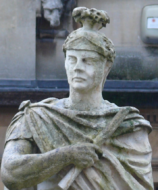
Other finds have been made also dating from this time west of the river Derwent at Strutts park near to the site of the later fort at Littlechester and at Trent Vale a mile south west of Stoke on Trent on a hill spur that would have marked the edge of the Cheshire plain
In AD 70 a new northern policy was initiated by the governor Petilius Cerialis,though this initially was centred on the eastern part of the Brigante empire although the problems of subduing the Welsh tribes prevented any final conquest.
A Roman army was almost certainly garrisoned at this time in York which also suggests that the power base of the Brigantes was east of the Pennines
That was left to Julius Frontinus who became governor in AD74 although all the evidence suggests that his campaign with the main threat east of the Pennines removed was to remain fairly static along with a further rebellion which broke out in South Wales with the Silures.
When Agricola became governor in AD77 the problem of the Western flank was still there and his first task as governor was back in North Wales against the Ordovices.
Once that was secure Agricola turned his attention to the area west of the Pennines founding the forts not only at Manchester but Castleshaw, Lancaster, Slack and Melandra
Agricola was father in law to Tacticus whom we have to thank for the first historical references to the settlement of Manchester and his biography of his father in law “Agricola” refers in detail to the campaign of AD79 in which the Roman’s subdued the tribes of the North West.
The Roman hegemony over the region followed the pattern of their conquest throughout Europe,roads criss crossing the region allied with forts.The major East West axis began in Chester and crosses the Pennines to York on which the Manchester site stood but it was also on the Northern route which ultimately ended in Carlisle
Next in the series-Roman Manchester