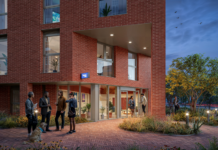

Across UK cities, timber cladding has become an increasingly visible part of residential and mixed-use architecture. In places like Manchester, where regeneration projects sit alongside existing housing stock, timber is often used to soften façades, introduce texture, and support sustainability goals. At the same time, fire safety has moved to the centre of material decision-making, particularly for external wall systems.
This has changed how timber cladding is specified. Choices that were once driven primarily by appearance or cost are now shaped by regulatory compliance, insurer expectations, and long-term performance risk. For developers, designers, and building owners, the challenge is no longer whether timber can be used, but how to choose timber responsibly within modern fire-safety frameworks.
Fire Safety as a Design Constraint, Not an Afterthought
Fire performance now influences external wall design from the earliest stages. Reaction-to-fire classifications, system testing, and documentation requirements all shape what is acceptable, particularly on residential buildings and those above defined height thresholds.
In urban environments, where density and mixed occupancy increase risk exposure, clarity around compliance is essential. Misunderstandings around timber’s role in fire safety can delay approvals or force late design changes, often at significant cost.
Understanding how to approach choosing the right fire-rated timber cladding therefore becomes a strategic decision rather than a purely technical one.
What “Fire-Rated” Really Means in Practice
The term “fire-rated timber” is often used loosely, but it is important to be precise. Timber remains a combustible material. Fire rating refers to how a product or system behaves when exposed to fire, not whether it will burn.
Fire retardant treatments can improve reaction-to-fire performance by slowing flame spread and reducing heat release in early stages of a fire. However, these treatments are assessed under controlled conditions and must be applied, maintained, and protected in line with certification requirements.
Crucially, fire performance does not belong to the timber board alone. It emerges from the interaction between cladding, insulation, cavity barriers, membranes, fixings, and detailing.
System-Level Thinking in External Walls
One of the most significant shifts in recent years has been the move away from product-led fire decisions toward system-level assessment. External wall systems behave as a whole. Cavities can act as pathways for fire spread if not properly compartmentalised, and insulation choice can significantly influence fire dynamics behind the cladding.
Timber cladding specified without considering cavity depth, barrier placement, and interface detailing introduces unnecessary risk. Conversely, timber integrated into a properly designed system can meet regulatory expectations in appropriate applications.
This places greater responsibility on early coordination between architects, fire engineers, and façade designers.
Material Choice Under Fire Constraints
Once fire performance requirements are defined, material choice becomes a balancing act. Naturally durable timbers, modified products, and treated softwoods all offer different combinations of performance, cost, and predictability.
Some timbers may meet reaction-to-fire requirements more easily after treatment, while others offer greater dimensional stability but require additional consideration around fixings or surface durability. No single option is universally “best”; suitability depends on the building type, height, and exposure conditions.
Urban projects, in particular, benefit from materials that reduce uncertainty rather than maximise specification claims.
ThermoWood and Treated Softwood in a Fire-Aware Context
A common comparison in fire-sensitive projects is between thermally modified timber, such as ThermoWood, and pressure-treated softwood. Both are widely used, but they behave differently and carry different implications for long-term performance.
Pressure-treated softwoods rely on chemical preservatives to resist decay. When combined with appropriate fire retardant treatments, they can achieve required reaction-to-fire classifications. However, their dimensional behaviour remains similar to untreated timber, meaning movement must still be carefully managed.
Thermally modified timber alters the timber’s internal structure, reducing moisture uptake and improving stability. This can be advantageous on large façades where movement could compromise coatings or fire treatments over time. However, thermal modification alone does not improve fire performance and must still be combined with suitable fire-retardant strategies.
Comparing ThermoWood versus treated softwood cladding within a fire-aware framework highlights the importance of separating durability, stability, and fire performance rather than assuming one solution addresses all three.
Durability, Maintenance, and Fire Performance Over Time
Fire performance is not static. Surface treatments can degrade due to weathering, UV exposure, or mechanical damage. Maintenance regimes therefore become part of the fire strategy, not just an aesthetic concern.
In urban residential settings, long-term access for inspection and maintenance can be limited. Materials that maintain performance with minimal intervention reduce both safety risk and operational complexity. This often favours solutions with predictable ageing behaviour and clear maintenance requirements.
Failure to plan for this reality can undermine compliance long after a building has been signed off.
The Role of Insurers and Building Control
Beyond formal regulation, insurers and building control bodies play a significant role in shaping acceptable solutions. Requirements may vary depending on perceived risk, occupancy type, and building height.
Clear documentation, third-party certification, and evidence of system performance increasingly influence approval outcomes. Ambiguity or reliance on assumptions can trigger delays or rejection, particularly on residential developments where public scrutiny is high.
This environment rewards conservative, well-documented choices over experimental or marginal solutions.
Urban Context and Public Confidence
In cities, fire safety is not just a technical issue; it is a public one. Residents expect transparency and reassurance, particularly in the wake of past failures associated with external wall systems. Timber cladding decisions must therefore stand up not only to regulatory assessment but also to public scrutiny.
Clear communication around why a material has been chosen, how it performs in fire, and how it will be maintained over time helps build confidence and reduces resistance to timber use in urban settings.
Making Informed, Defensible Choices
Fire-rated timber cladding can play a role in modern urban architecture, but it demands a higher level of discipline than ever before. Material choice must be aligned with system design, regulatory context, and long-term maintenance planning.
Where these factors are addressed together, timber remains a viable and attractive option. Where they are treated separately, risk increases quickly.
In today’s regulatory environment, successful timber cladding projects are those that prioritise clarity, evidence, and system thinking over assumption or habit.