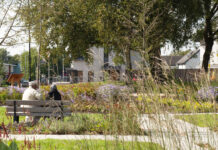

A moonless but starry night was considered the best time to visit the park,alighting from the tram, going through the gates and finding oneself in an avenue of trees, with a ghostly brook beneath you, the hum of the tram cars and the violet flashes from the overhead lines as they pass up Valentine Brow and you approached the mysterious fountain enclosed by trees, where the Boggart used to pinch the children in bed or make the cheese go off.
So wrote one writer in the 1920’s for those visiting Boggart Hole Clough in Moston
Reputedly one of the region’s most spooky places,The Clough, though is said to hide greater secrets.
Tales of Boggart’s litter the countryside of Lancashire.The chief of the Boggarts would assemble his clan twice a year on the night of a full moon on top of Rivington Pike and all, along with their wives would have to attend on pain of losing their powers so the ancient story goes
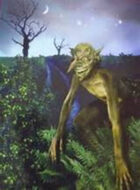
While The Green Boggart which inhabited the moss lands north of the Mersey was worried as humans or forkypeds, were draining the area for land and depriving him of his evil powers that came from the water.
Told to do better by the chief and hungry as humans were no longer getting caught in the mosses, he wandered the land looking for new territory.He crossed the Mersey and roamed around Cheshire before finding an attractive forkyped over the border in Wales.
The female dressed in black with long lustrous hair of the same colour was Morgan La Faye, a sorceress who lived with Merlin the Wizard in Camelot.
Together they hatched a plan to restore the strength of the Green Boggart, giving him powers to assume the form of a human when needed and in return he must renounce his allegiance to the Boggart chief and stop referring to humans as Forkypeds.She chose a suitable place for him to live, a dark clough to the east of Manchester, wild and lonely, wooded on all sides and with only one way in and one way out.To feed the Boggart wouild have to live like a human and forage the villages and folds for food when needed.
He soon became bored, despite visits from Morgan who told of the tales of Camelot and began to amuse himself by playing pranks on people and their animals.One trick was to make himself very tall and creep into the ear of a horse, frightening it so, that it would gallop off in all directions.Another would be to enter the houses of people who were not protected by charms and rather like a poltergeist, pots and pans would fly off shelves, cupboard doors open and shut and water would douse the fire. Children would wake in the middle of the night to find themselves sleeping upside down.
One farmer, George Cheetham, was particularly selected, the Boggart scaring the maids out of their wits and even joining in the laughter as stories were told around the table until the youngest of the farmer’s sons Robert, cried out “weel laughted boggart, if we could catch a glent of thee”
The boggart disappeared for months and was never heard to laugh again, affronted by Robert’s familiarity.Instead, in the dead of night, he would come to the bedroom where Robert and his brother slept, one brother short and one tall and would pull at their feet shouting “short and long wont match, short and long wont match, ho ho ho”
Eventually the family would be forced to leave the farm, but as the horse and cart left with the belongings stacked up the boggart was heard to call “I’m going too”
Whether the Boggart actually left was a mute point.The family who lived in the farm house at the Clough told of a strange spirit who would sometimes help out with the washing and cleaning, while other times throw items around, pull bedcovers from people’s beds as they slept, and laugh loudly while banging around at night. When the family threatened to move out, the spirit told them it would go with them,so they stayed.
The Boggart, though dismissed by Ward in his Moston Characters at play as scarcely worth mentioning, was said to be a pure white animal with glaring eyes, only seen at night and around the size of a large fox. Strange animal noises were said to emanate from it from those who saw it, including Emanual Hird, a tenant farmer whose numerous sightings were said to have led to his fleeing of the area.
The people of Nuthurst farm believed that they had caught it.After it had not been seen for some time, a man prowling through the dingle came across a strange animal caught in the briars overhanging the brook which ran through the area. It had been dead for some weeks and had almost dried up.It had cloven hooves and short hair like that of a mouse and was taken to the Blue Boar where it was displayed for all and sundry
Sam Bamford, who told that the race of Boggarts had “long since flitted” would refer to the place as Fyren Ho Kloof or the glen of the hall of the spirits in his passages of the life of a radical and speaks of an ancient and desolate looking house at the bottom of the glen,Edwin Waugh dismissed tales of ghosts but described it as a picturesque little glen.
Bamford would use his writing to proliferate ghostly tales, referring to a house at the head of the Clough which had the reputation of being the home of an unquiet spirit.She was a taciturn and beautiful peasant woman, wife of a former tenant who silently roamed the house, lamenting past loves.
So if you choose to roam the Clough on these dark winter evenings, keep an eye out him