
For someone growing up in the 1970’s and 1980’s the latest exhibition opening this weekend at Manchester’s People’s History Museum was rather akin to the News at 10 on a continuous loop
Grunwick, Miners, Wapping, they are all here at the Museum uses the centenary of the General Strike to put on an exhibition On The Line: 100 years of strikes exploring this historic watershed and takes visitors on a journey through the hundred years of turbulent industrial relations that followed.
For those who don’t know a quick reminder of our history.
The 1926 General Strike only officially lasted nine days, but its impact was seismic. Between 4 and 12 May 1926, the entire country was brought to a standstill when three million workers in transport, railways, engineering, printing, shipping, and other industries withdrew their labour in an unprecedented act of unity called by the Trade Union Congress (TUC).
 This remarkable expression of national solidarity was in support of more than a million miners who had been locked out of work for refusing to accept lower pay and longer hours.
Although the strike was called off without guarantees, leaving the miners to fight on for another seven long months, it remains a defining chapter in the history of organised labour.
With that in mind the exhibition charts the next 100 years, 1972 Miners’ Strike over wages and hours, the Grunwick Strike for union recognition(1976–1978), and the women of Ford Dagenham who took action for equal pay in 1968.
Photography is also used to show objects from the exhibition in use on the frontline, in both historic and contemporary strikes. Objects on display include a full–scale Ambulance Strike Shelter which is from the ambulance workers’ pay dispute of 1989-1990.
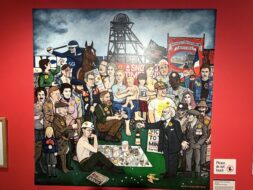
Industrial struggle is rarely captured in fine art, but On The Line features two oil paintings going on public display for the first time.
Taking Scabs To Work, Barking Hospital by artist S. Rushton, thought to have been painted around 1984, tells the story of a strike that occurred following the privatisation of hospital cleaning services, which resulted in a cut in cleaning hours and impacted workers’ rights. It is believed that this scene, presented as a piece of traditional art, is referencing the 24 hour picket that was held and which led to the arrest of many activists by the police. In contrasting style, David Rumsey’s The Past Is Another Country is a vibrant, graphic work depicting key figures and scenes from the Miners’ Strike (1984-1985), including the Battle of Orgreave. Begun in 1984, the piece was a labour of love that took almost 30 years to complete.
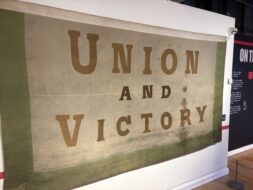
These paintings are displayed alongside protest banners from PHM’s collection. These include the oldest object in the exhibition, the Union and Victory banner, which was first seen during the Great Dock Strike of 1889. Many of the banners are artworks in their own right, which is certainly the case with the Grunwick Strike Committee banner. This is one of several objects marking the 50th anniversary of this extraordinary event. Led by Jayaben Desai (1933–2010), a migrant worker originally from India who settled in Tanzania and later moved to Britain, the strike saw workers stand up to their managers in a fight for rights and representation, sparking one of the largest mobilisations in labour movement history.
Jayaben’s is one of many powerful stories told in the exhibition. The solidarity that met the Grunwick strikers is echoed from the perspective of those providing the support in the story of Women Against Pit Closures, which began as grassroots groups scattered around the country formed by women and miners’ wives during the Miners’ Strike (1984-1985) and grew into a nationwide movement. They organised essential support to the strikers – fundraising, public speaking, distribution of food, and picketing – and their story is visually represented as the lifeline that it providedthrough t-shirts, posters, and images.
Historic objects from PHM’s collection are exhibited with some of the most recent objects to be added to its collection. These include the Deceptioncon robot costume (2023-4), which was created to be worn by employees fighting for their right to unionise at Amazon’s Coventry warehouse. The robot symbolised the feelings of workers, who felt that they were being treated like robots.
The Exhibition brings us right up to date with images from the recent junior doctors strike, the rail strikes and Uber Delivery riders
People’s History Museum’s opening hours are 10.00am to 5.00pm, every day except Tuesdays. Gather café is open 10.00am to 5.00pm, every day except Tuesdays, serving hot food until 3.00pm. PHM has a Changing Places toilet and lifts to its galleries. Museum entry is free, with most visitors donating £10. For further information about PHM, its latest programme of events and visiting the museum visit phm.org.uk, and you can keep up to date with the latest news by signing up to receive PHM’s e-newsletter.