

Europe saw one of its warmest years on record in 2025 with rapid warming in Europe is reducing snow and ice cover, while dangerously high air temperatures, drought, heatwaves and record ocean temperatures are affecting regions from the Arctic to the Mediterranean.
Europe, along with many other regions of the globe, is exposed to increasing impacts – from record heatwaves on land and at sea, to devastating wildfires, and continuing biodiversity loss – with consequences for societies and ecosystems across Europe.
The findings are released today within the European State of the Climate (ESOTC) 2025 report, produced by the European Centre for Medium-Range Weather Forecasts (ECMWF), which implements the Copernicus Climate Change Service, and the World Meteorological Organization (WMO).
The report brings together the work of around 100 scientific contributors and provides a comprehensive overview of key changes in climate indicators for the world’s fastest warming continent, including cold environments, marine ecosystems, rivers and lakes, wildfire risk, and more. A wide range of graphics and visuals highlighting key findings from the data are being made available.
The report shows a continuing trend of rapid warming across Europe’s coldest regions –including in the Arctic and the Alps, where snow and ice play a critical role in slowing climate change by reflecting sunlight back into space (the albedo effect).
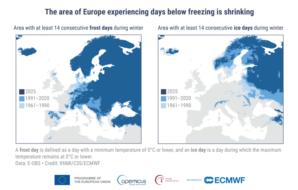
At least 95% of Europe experienced above-average annual temperatures in 2025, while the area of Europe experiencing winter days with freezing temperatures is shrinking. Sub-Arctic Fennoscandia saw its longest heatwave on record in July, spanning three weeks. During that period, temperatures close to and within the Arctic Circle reached and exceeded 30°C, peaking at 34.9°C in Frosta, Norway. Meanwhile, Europe as a whole saw a record low number of cold stress days, with 90% of the continent experiencing fewer days than average with at least ‘strong’ cold stress. Minimum temperatures remained above average for most of the year.
Above-average temperature and below-average precipitation led to a significant loss of snow and ice cover. In March 2025, the snow-covered area in Europe was about 1.32 million square kilometres (31%) below average – equivalent to the combined area of France, Italy, Germany, Switzerland, and Austria. This marked the third lowest snow extent since records began in 1983.
Glaciers also experienced a net mass loss, with Iceland recording its second-largest glacier mass loss on record. Additionally, the Greenland Ice Sheet lost 139 gigatonnes (139 billion tonnes) of ice – around 1.5 times the volume stored in all glaciers in the European Alps. This ice loss contributes to rising global sea levels, with every centimetre increase exposing an additional 6 million people to coastal flooding.
The global ocean has absorbed about 90% of the excess heat caused by human-induced greenhouse gas emissions. In 2025, the European ocean region experienced its highest annual sea surface temperature on record, marking the fourth consecutive year of record warmth. This long-term trend negatively affects biodiversity, species, and habitats. Marine heatwaves can also coincide with heatwaves over land – contributing to more extreme temperatures and humidity, including overnight, which can slow people’s recovery from heat stress and disrupt sleep.
Marine heatwaves were widespread in 2025, affecting 86% of Europe’s ocean region. They were also more intense, with 36% of the region experiencing ‘severe’ or ‘extreme’ conditions – the highest proportion on record. 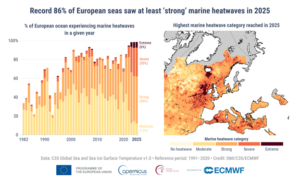
Across Europe, around 70% of rivers experienced below-average flows, while it was one of the three driest years for soil moisture since 1992. In May, around half of Europe (53%) was affected by drought conditions. These patterns reflect a combination of factors including atmospheric circulation and rainfall variability, alongside longer-term climate trends.
Across Europe, 2025 saw widespread warm conditions – with above-average temperatures recorded across at least 95% of the continent. Heatwaves affected large parts of Europe, from the Mediterranean to the Arctic, including Europe’s second most severe heatwave on record and sub-Arctic Fennoscandia’s longest and most severe heatwave, in July. Much of Europe also experienced more days than average with at least ‘strong’ heat stress, with southern and eastern Spain recording up to 50 more days than average with ‘feels-like’ temperatures above 32ºC.
Hot and dry conditions contributed to record wildfire activity across Europe. In total, a record area of around 1,034,000 hectares burnt across Europe – an area larger than Cyprus – with wildfire emissions reaching their highest levels on record. Spain was particularly severely impacted and accounted for around half of the emissions.
Alongside Spain, Cyprus, the United Kingdom, the Netherlands, and Germany recorded their highest wildfire emissions on record. Wildfires also pose a significant risk to biodiversity and peatland wildfires can release large stores of carbon, further amplifying climate change. The European Commission has identified rising wildfire risk as a key priority, as projections by the Intergovernmental Panel on Climate Change’s Sixth Assessment Report show that wildfire threats are likely to increase across all regions of Europe.
Numerous extreme events in 2025 – including drought, wildfires, and land and marine heatwaves – impacted biodiversity in marine and terrestrial ecosystems. Additionally, nature is under increased stress due to shrinking and shifting habitats, disruption of seasonal patterns due to warmer temperatures, and changes in precipitation.
The report outlines concrete examples of climate change impacts on sensitive ecosystems, such as the impacts of marine heatwaves on seagrass meadows in the Mediterranean Sea, and peatland wildfires. Environmental governance in Europe has increasingly recognised the close links between climate and biodiversity, with coordinated ‘nature-climate’ approaches designed to strengthen ecosystem resilience.