
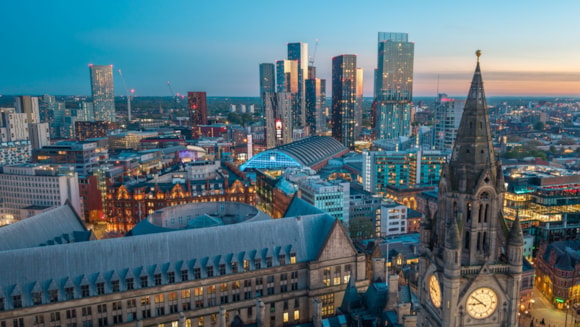
Manchester and the city region remain one of the fastest growing and most productive big city economies in the UK – as outlined in a new Centre for Cities report.
The report – the Big Cities Outlook – singles Manchester out as a standout success story for growth and productivity, consistently leading big city economic growth both before and since the financial crash.
It says: “Improving the economic performance of big cities is important not only for raising living standards within cities, but also for their wider regions”.
The nine largest cities outside of London represent a sixth of the UK’s population and they typically have above-average workplace wages for their regions, helping to drive up living standards outside of London.
They have the potential to add £35bn to national economic output annually, generating more prosperity for their wider regions. Given the importance of urban economies – especially big cities like Leeds and Manchester – to cutting-edge “Industrial Strategy” sectors like AI and financial services, they could likely add even more.
Over the last decade, Manchester and the city region have recorded a 19.7% increase in job growth, significantly above the UK average of 13.9% – supported by a strong pipeline of high quality office space to attract and help businesses to grow. This pipeline will remain an important driver to support the fast-growing knowledge-economy sectors in the city.
Manchester continues to grow a large and globally renowned knowledge-economy – with breakout sectors in digital, fintech and research – with 244,000 knowledge-intensive business services (KIBS) jobs located in the city, second only to London among big UK cities.
KIBS jobs now account for 17.6% of all jobs, above the national average of 14.5% strengthening Manchester’s position as one of the UK’s leading growth cities.
In December 2023, Manchester launched ‘Investing in Success’, an economic strategy built on the principle of inclusive growth – delivering jobs for Manchester people to lift people out of poverty, while highlighting the need for housing investment to help our residents to thrive.
Since the adopting of the strategy, the employment rate in Manchester increased to more than 75% – which represents a 6.4% increase since 2023.
And the strength of Manchester’s business community, a key driver of employment growth, shows a trend of ongoing success. There has been a 30% rise in the number of businesses in Manchester since 2015 – and the total number of businesses in the city grew by around 900 in 24/25 alone.
Nationally, housing supply remains a challenging factor and the Centre for Cities report outlines a need for increased housing density, particularly in the city centre and transport-linked affordable housing opportunities across the city. Manchester is tackling this issue head on through an ambitious housing strategy to deliver at last 36,000 homes across the city up to 2032 – with at least 10,000 capped at affordable tenures.
Four years into the strategy, the Council recorded a record year for affordable and social housing completions in the last 12months, where nearly 1,000 affordable homes were completed, half of which are capped at social housing rate, helping to meet significant demand and helping to reduce the number of households on the housing register for the first time since the pandemic.
Investment in transport is cited as a powerful driver for local economies, capable of helping to reduce deprivation through well-connected communities and easy access to employment opportunities – such as the plan to deliver a new Metrolink stop at Sandhills as part of the ongoing major regeneration of Collyhurst within the Victoria North programme.