
In what is a massive moment for the city Manchester has now been officially recognised as a UNICEF Child Friendly City – which comes after nearly four years of working closely with children and young people, along with other partners in the city, to change and improve policies and services to make sure children’s rights are at the heart of them.
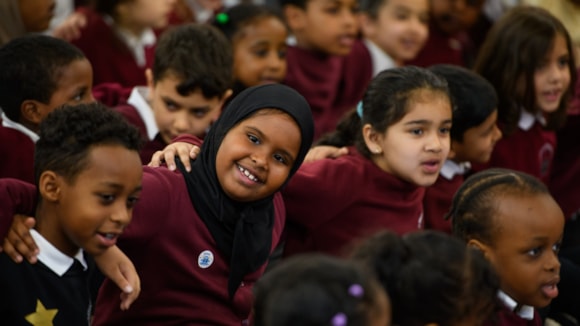
The news of Manchester gaining Child Friendly City recognition was announced first to pupils at St Mary’s CE Primary School in Moss Side at the end of last week by young people themselves – with two children given the honour of sharing the news with the rest of the school in a golden envelope reveal moment during a special assembly which included pupils speaking passionately about what children’s rights mean to them.
The whole school assembly also saw the signing of a pledge by Councillor Bev Craig and senior leaders from the council on behalf of the city, committing Manchester to keeping children’s rights front and centre in everything it does.
St Mary’s CE Primary School is one of the more than 80 per cent of schools in Manchester that have already earned recognition as Rights Respecting Schools – schools where day in, day out, children are taught about the United Nations Convention on the Rights of the Child. Headteacher Jenny McGarry is also a Child Friendly City Ambassador.
At the start of the city’s journey to become a Child Friendly City one young person said: “I hope Manchester becomes a rights respecting city, just like my school is.”
Manchester was accepted onto the Child Friendly City programme by UNICEF UK towards the end of 2022, off the back of the council’s own hugely successful ‘Our Year’ twelve-month programme of child-centred activities and opportunities for the city’s young people that took place throughout 2022.
Since then, the last three-plus years have seen the local authority and its partners taking part in UNICEF UK’s Child Friendly Cities and Communities programme, developing and implementing strategies for advancing children’s rights and working towards achieving ‘Child Friendly City’ status as recognised by UNICEF.
In practice this involved taking a step back to look at existing policies, service delivery, and decision-making processes from a child’s perspective to see how they could be changed and further improved to make sure children’s rights are fully embedded and at the heart of everything the council and its partners do.
Seven key priority areas were identified for the city to work on, which included co-operation and leadership, communication, culture, as well as a four priorities chosen by children and young people – healthy, place, safe and secure, with a ‘golden thread’ of equal and included running throughout each of the priority areas.
Regular scrutiny of the council’s progress towards achieving Child Friendly City status was carried out by UNICEF UK throughout the city’s journey towards recognition, with children and young people also closely involved.
As a result, the city is now a much-changed place from its starting point in 2022 in terms of both its understanding of children’s rights and incorporating a children’s rights-based approach to the policies it makes and services it delivers.
Key highlights include direct engagement with thousands of children and young people, including care-experienced young people, young carers, children with SEND, and newly arrived children, helping influence decisions on real issues that affect their lives, from health and wellbeing to safety and justice; children helping redesign services and create youth-friendly standards, and shape cultural and creative programmes in libraries, youth and community spaces; and children’s rights now embedded in council decision-making.
Alongside these changes, extra investment of more than £1.8m in parks and play, means children have been able to help shape improvements to their local environments and take part in a greater number of activities after school and in school holidays. Additional investment has also seen the introduction of free membership in council-owned gyms for all 11 to 16-year-olds in Manchester high schools, and the expansion of free swimming for under-16s in leisure centres across the city.
Councillor Bev Craig, Leader of Manchester City Council, said: “Every child and young person in our city deserves the best and we set out on a mission for Manchester to become the best city to grow up in.
“In 2022 we wanted to put the voices of children and young people at the heart of what we do, so we embarked on a radical new approach. One that doesn’t wait until you’re 18 to have a say. We’ve spoken to tens of thousands of young people of all ages since then, asking them directly what they want to see our city be, and have responded to what they have told us.
“It’s great news that after a lot of hard work Manchester is now officially recognised by UNICEF as a Child Friendly City – it’s a celebration of the start of the next stage in our journey of delivering these priorities.
“It also comes at a time when we are investing heavily in our children and are seeing the difference. From better services, like our Ofsted Outstanding children’s services, better quality schools and better exam results, more youth services, better parks and play facilities, and ultimately more young people getting into good jobs- all of these things go hand in hand.”