

A report out this week by the Global Advisory Firm Oxford Economics has spotlighted Manchester as a a place where there is positive momentum in terms of growth
A collapse in London’s productivity growth coupled with persistent underperformance in the UK’s other major cities lie behind the current productivity malaise, which is at the heart of the country’s weak wage growth and fiscal challenges says the report but Manchester is bucking the trend
Greater Manchester’s productivity has notably outstripped the rest of the country,” says the analysis “driven by strong growth in the city centre and in some of the most productive sectors of its economy.
“Given the growing importance of knowledge-intensive and advanced service sectors globally, UK city-regions such as Manchester should be well-positioned to continue their strong growth rates,” it adds
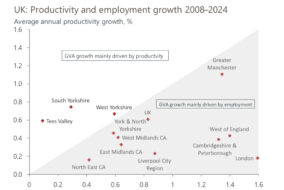
A major part of the region’s success has been an accelerating industrial transition within Greater Manchester.
The MCA now enjoys a more favourable industrial composition than the national average, as evidenced by the increasing share of workers in high-productivity sectors.
A prime example of this has been the strong growth in Knowledge Intensive Business Services (KIBS) that Greater Manchester has experienced since 2008. Employment in Greater Manchester’s KIBS sector has expanded faster than the national average, London, and all other MCAs with close to half of these jobs concentrated in the city centre.
Meanwhile, Greater Manchester also leads the way on overall GVA growth since the GFC; this is perhaps unsurprising given its strong productivity performance, though it is worth nothing that that it has paired this productivity growth with strong employment growth
However with London making up almost a quarter of the UK economy and 17% of its workforce, any hope of significantly boosting the UK’s productivity growth must include an improvement in the capital’s recent performance.
To some extent, these very specific growth constraints in London, such as around poor housing supply, are driving a total national slowdown.
Hence, policymakers need to both unlock growth in London while simultaneously promoting longer-term diversification and stronger performance of cities outside of the capital, to ensure that the UK’s economy can be more resilient.