

Uganda is known as the “Pearl of Africa,” and offers one of the finest topographies in the world for growing quality coffee beans. From the fertile volcanic slopes of Mount Elgon in the east to the Rwenzori Mountains in the west, each region boasts unique growing conditions and flavours.
The coffee grown on its soil has an exquisite, distinct taste, and the country has been harvesting the beans for over 200 years. Robusta coffee beans first started growing in the wild forests bordering Lake Victoria over two hundred years ago, and by the late 19th century, Ugandan Robusta was finding its way into European markets. This was followed by Arabica beans that were introduced to the country by missionaries in the 20th century.
Today, coffee is a vital part of Uganda’s economy, employing over 1.7 million households and contributing significantly to foreign exchange earnings. Uganda is the 7th largest coffee producer globally
However, a cup of Ugandan coffee is hard to find on UK soil, with the coffee market dominated by imports from Brazil, Colombia, Ethiopia, and Vietnam. According to the British Coffee Association, coffee consumption in the UK is among the highest in the world, with an average of 2.3 cups per person per day, yet Ugandan coffee accounts for a mere 1% of the UK’s total coffee imports.
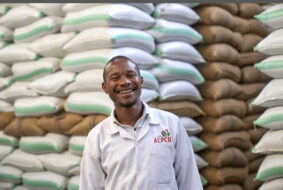
Now, a new wave of Ugandan coffee producers championing sustainable farming, empowering women and transforming local communities, are hoping to change that. Indeed, Ugandan coffee will be making its first group appearance at the annual Manchester Coffee Festival (14-16th November), where it will join over 50 other producers from the UK and around the globe, to showcase its delicious beans and pioneering growers.
With support from the UK Trade Partnerships Programme, they are taking their message directly to British coffee drinkers and industry players, inviting them to discover the rich flavours and stories behind Uganda’s specialty coffee.
The country’s young generation of pioneering growers are dedicated to driving community uplift, including support for local schools, financial education and youth programmes. Their practices are steeped in sustainability from bean to cup, with agroforestry, climate-smart agriculture and initiatives such as shade-planting and beekeeping in place. Not to mention many farms have a female-led workforce, who they upskill with technical training and fair wages.
For example, Mountain Harvest, set on the ridges of Mount Elgon, is dedicated to empowering women through coffee production and has grown the number of women it works with from 13% in 2019 to 41% in 2025.
Whilst Ankole Cooperative Union, located in the fertile volcanic soils of Southwestern Uganda, at altitudes ranging from 1400 to 1900 metres above sea level, is committed to developing local communities and has helped fund schools in the villages they work with. Its member farmers each manage small-scale farms averaging 1.5 acres, carefully tending to 600-700 coffee trees. Their farming practices include maintaining healthy soils, pruning the coffee bushes, and intercropping with nutrient-rich trees and plants such as bananas, providing partial shade and mulch for the soil. With their high altitude these farms produce coffee that exhibits a distinctive cup profile with floral, fruity, and sweet notes.
Zamani Coffee was founded as a movement to empower small-scale farmers. Its beans are cultivated by 250 dedicated small-scale farmers in the Sipi region, who weave traditional methods with innovation to nurture the land that sustains them. Zamani provides ongoing education on sustainable farming and post-harvest practises to help achieve higher profitability whilst looking after their environment. It established the ‘Sipi Zamani Coffee Farmers Savings Cooperative’, a platform that empowers farmers to save, plan and deliver community-driven initiatives.
Ugandan Coffee will make its mark with British coffee