
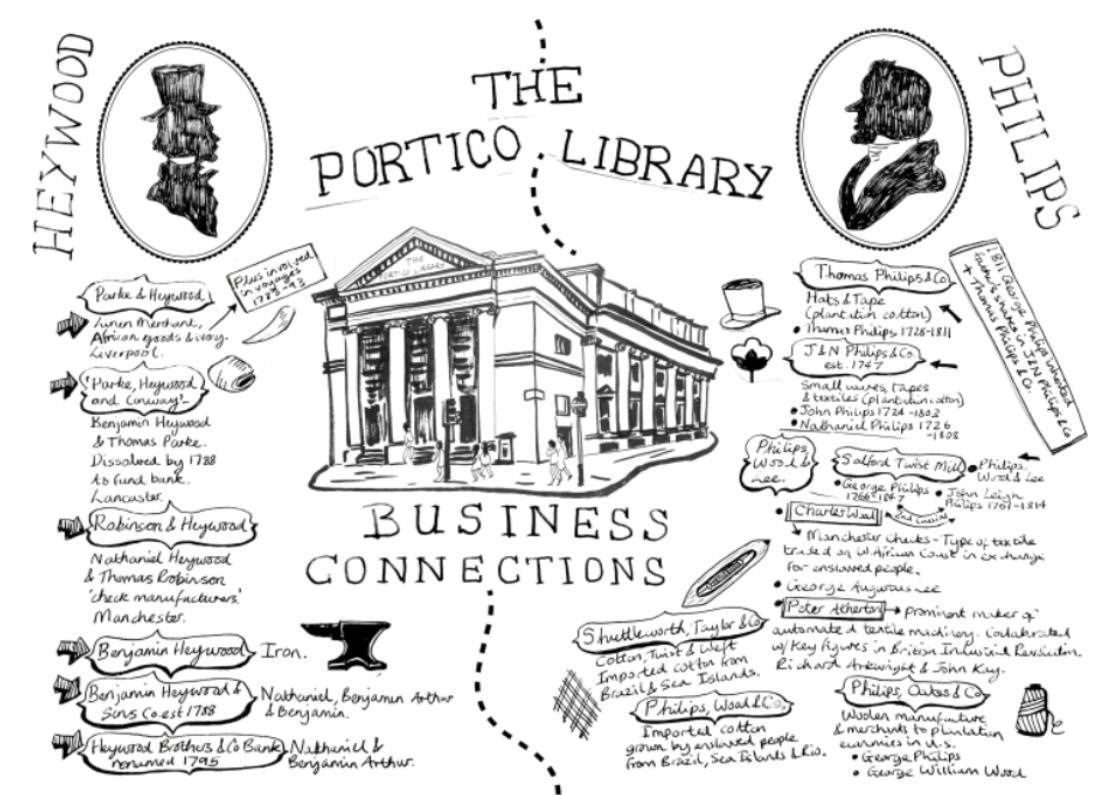
Ground-breaking research has pinpointed Manchester’s historic Portico Library and Newsroom as influential in the city’s connections to the transatlantic slave trade economy.
The research by Manchester’s Global Threads team traces the library’s foundation in 1802 as an exclusive members’ Library to profits and individuals linked to the city’s underacknowledged history connected to the transatlantic slave trade.
Researchers Jeevan Kaur Sanghera and Ella Sinclair have discovered never-before-seen connections between the institution and histories of enslavement, exploitation, and the resistance of enslaved people in the Caribbean.
The Library counted among its list of influential members former Prime Minister Robert Peel, Sir George Philips, a financier of the Manchester Guardian (now the Guardian), alongside others from Manchester’s male elite.
Using cutting-edge research techniques to produce seven case studies, the research team have traced direct links between the Portico’s prominent members to transatlantic slavery and colonial economies across the globe – from Haiti, to Jamaica, Grenada, St. Lucia, the United States, and beyond.
The research tells a transatlantic history of the Portico Library – and Manchester – stretching its limits beyond the boundaries of the city, connecting its history to the enslaved people and communities directly impacted by Britain’s transatlantic slave trade and colonial pursuits. By bringing these human experiences to the forefront the research provides crucial context for ongoing reparative justice agendas.
Dr Thom Keep, CEO of The Portico Library says,
“This research not only helps to recover the lost connections to enslavement the Portico Library was built from, it also helps us understand Manchester’s past in a different way – helping us to imagine a future inspired by previously silenced voices and histories. We want to put these new research findings at the
service of visitors and community members for reflection, and response, informing how they can help shape the future of the institution.”