
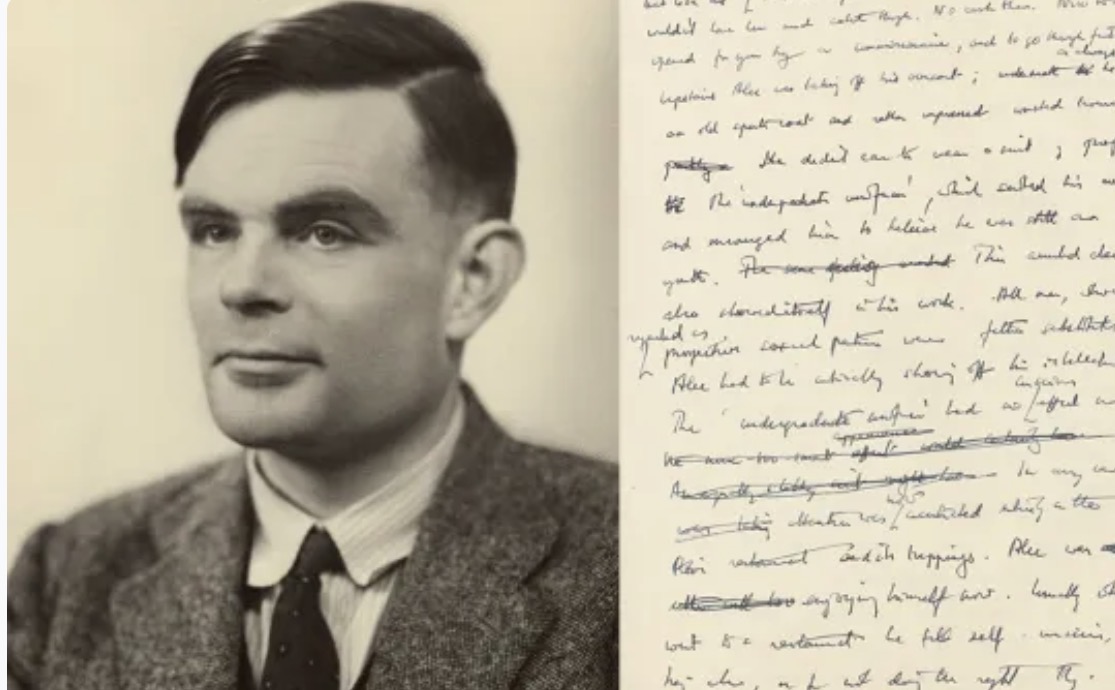
A startling new study of a little-known, unpublished short story by Alan Turing challenges our understanding of the man who played a key role in cracking the Nazi’s Enigma code, developed the theoretical underpinning of the first computers, and laid the groundwork for the development of artificial intelligence.
‘Pryce’s Buoy’, a six-page, scruffily hand-written fragment of a short story cared for by archivists at King’s College Cambridge has been transcribed and fully studied for the first time.
Professor Sarah Dillon’s findings, published today in The Review of English Studies, will surprise anyone who accepts The Imitation Game’s portrayal of Turing.
“We’ve distilled a version of Turing that is a two-dimensional stereotype,” says Dillon, a Professor at Cambridge’s Faculty of English.
“He’s come to be seen as socially unaware, entirely concerned with logic and numbers, and pretty isolated. His short story reveals a very different man: playful, funny, cheeky, literary, and someone who really liked sex.”
Turing’s story – which Dillon believes he wrote in late 1952 or early 1953 – centres on Ron Miller, a working-class rent boy; and Alec Pryce, a homosexual scientist famed for an invention in his twenties known as ‘Pryce’s buoy’, hence the title sometimes given to the story.
Alec’s character is clearly autofictional – he represents Turing himself – and Dillon has no doubt that ‘Pryce’s Buoy’ is a direct fictionalisation of the late 1951 sexual encounter which led to Turing’s arrest.
Tired after a period of intense work and Christmas shopping, Alec feels he’s ‘earned’ some fun and goes looking for a young man. The narrator then switches from Alec’s mind to Ron’s. He’s broke, unemployed and looking to make some money from sex.
Ron thinks to himself: ‘If he let someone take him under the arches for ten minutes he might get five bob.’
He spots a ‘chap’ giving him a look as he walks past. Turing writes: ‘Ron caught Alec’s eye and gave him a half-hearted smile. It was enough though.’
Sat on a park bench, the men assess the situation and each other. Ron thinks Alec is shabbily dressed but wealthy-ish. Ron wonders: ‘Could he be mistaken? No, he was having a furtive look. Just a bit shy;’
Part of the 5th page of Turing’s story in which Alec and Ron first meet. © King’s College, Cambridge
Part of the 5th page of Turing’s story in which Alec and Ron first meet. © King’s College, Cambridge
Alec’s impression of Ron is: ‘Not a real beauty, but had a certain appeal. Beggars couldn’t be choosers.’
The pair then walk to a restaurant. Turing writes that Ron: ‘didn’t go in for lah-di-dah ways of talking. It’d come to the same anyway. Bed’s bed whatever way you get into it. Alec thought otherwise’.
Professor Dillon says: “I love the hesitancy, the way it evokes the uncertainty of potential sexual encounter, the ‘am I reading this situation wrong?’ worry. ‘Am I going to put my foot in it?’ ‘Am I going to go too far?’ ‘What did they want?’ ‘What do I want?’ ‘Can I back out?’ Turing gets those tensions, the leaning in and backing out. He does it really well.”
The story abruptly cuts off in the restaurant, mid-sentence at the bottom-right of a page, with the words ‘Ron wouldn’t’.
There was clearly more and that’s so frustrating,” says Dillon. “We don’t know where the rest of it went. We don’t know if Turing’s mum censored it. Did it get more sexually explicit? How did it end? That’s frustrating but everything else is so exciting.”
“Turing died when he was only 41, and in those years running up to his death, he was trying to understand himself and his world. Literature offered him a really powerful way of doing that. This was the moment when he really felt a release, a chance to be more creative and playful.”