
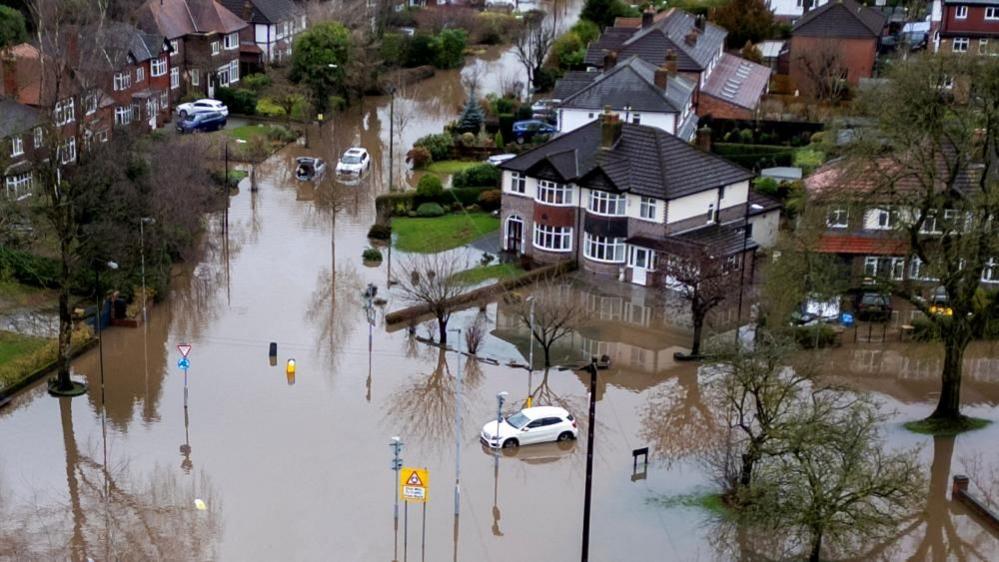
Record breaking and extreme weather has become increasingly commonplace in the UK as our climate has changed over the last few decades.
The latest assessment of the UK’s climate shows how baselines are shifting, records are becoming more frequent, and that temperature and rainfall extremes are becoming the norm.
The latest State of the UK Climate report, published by Wiley in the Royal Meteorological Society’s ‘International Journal of Climatology’, provides insight into the UK’s changing climate.
The report highlights how the UK’s climate has warmed steadily from the 1980s onwards, albeit with individual cooler years, with the greatest implications from the increasing frequency and intensity of daily temperature extremes.
The last three years have been in the UK’s top five warmest on record, with 2024 the fourth warmest year in records dating back to 1884. In 2024 specifically, we saw the UK’s second warmest February, warmest May, fifth warmest December, fifth warmest winter and warmest spring on record. Statistics like this are typical of recent years in the UK’s climate records and some of these have already been surpassed in 2025.
The report shows how the UK has warmed at a rate of approximately 0.25°C per decade since the 1980s, with the most recent decade (2015-2024) 1.24°C warmer than 1961-1990. Looking even further back, the Central England Temperature series shows that recent warming has far exceeded any observed temperatures in at least 300 years.
The report is based on observations from a network of several hundred weather stations, with temperature and rainfall data from these extending back to the 19th Century providing long term context. These data tell us how our climate has already changed here in the UK.
New analysis in the report examines the shifting frequency and intensity of heat and rainfall extremes. Understanding how these extremes are changing is particularly important because these tend to cause the greatest impacts, such as heatwaves or floods.
The number of days with temperatures 5°C above the 1961-1990 average has doubled for the most recent decade 2015-2024 compared to 1961-1990. For 8°C above average the number has trebled and for 10°C it has quadrupled. This shows how the hottest days we experience in the UK have increased in frequency dramatically in just a few decades.
When comparing the most recent decade 2015-2024 to 1961-1990, the hottest summer days and coldest winter nights have warmed around twice as much as average summer days and winter nights have in some parts of the UK.
At the same time, the frequency of the coldest nights we experience has also dropped dramatically.
Although there is much more variability with rainfall, it is still possible to see how extremes are being impacted here too. For the most recent decade 2015-2024, the number of months where counties are recording monthly rainfall totals of at least twice the 1991-2020 monthly average has increased by over 50% compared to the number in 1961-1990.
As the UK’s climate warms, it is also becoming wetter, with this report showing that the increase in rainfall is entirely due to an upward trend in the winter half-year (October to March). For 2015-2024 the winter half-year is now 16% wetter than 1961-1990 for the UK.
Met Office Climate Scientist and Lead Author of the State of the UK Climate report, Mike Kendon, said:
“Every year that goes by is another upward step on the warming trajectory our climate is on. Observations show that our climate in the UK is now notably different to what it was just a few decades ago. We are now seeing records being broken very frequently as we see temperature and rainfall extremes being the most affected by our changing climate.
“This pace of change and clustering of consecutive records is not a natural variation in our climate. Numerous studies have shown how human emissions of greenhouse gasses are warming the atmosphere and changing the weather we experience on the ground. Our climate in the UK is now different to what it was just a few decades ago, this is clear from our observations.”