
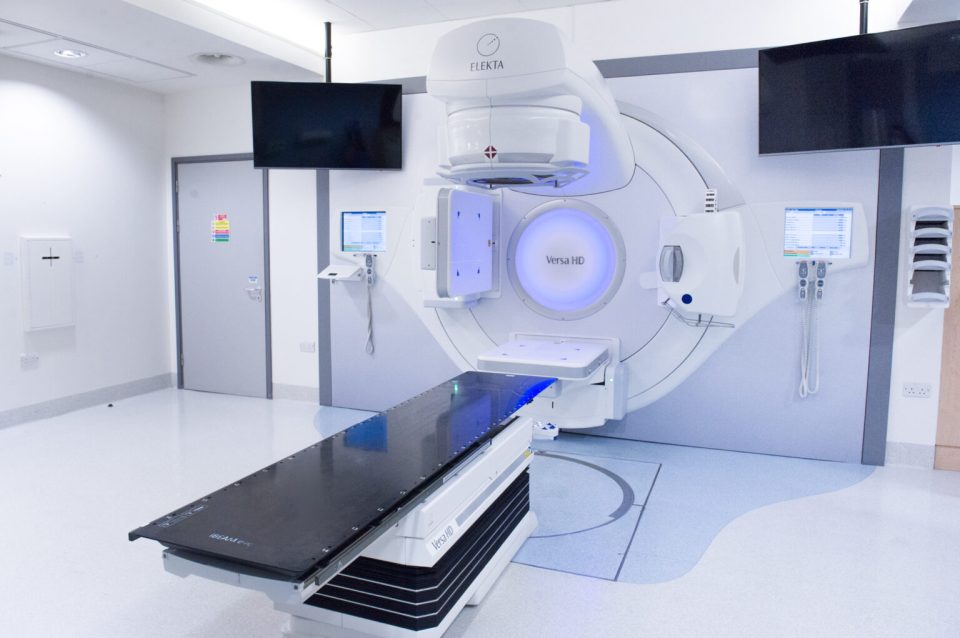
Thousands of men with prostate cancer are to be offered high-powered ‘precision’ radiotherapy on the NHS to target the disease more effectively, helping reduce side-effects and spare them 15 courses of treatment.
NHS England has today announced that, for the first time, eligible men with early prostate cancer will be offered pioneering therapy known as SABR on the NHS, which delivers a higher dose to the tumour with pinpoint accuracy to avoid harming healthy cells.
The highly targeted SABR (stereotactic ablative radiotherapy) delivers radiotherapy to the tumour from many different directions to help reduce the risk of cancer spreading or returning, and has been proven to be effective at far fewer doses than conventional radiotherapy.
The cutting-edge technique will be made available within days and will significantly reduce the number of hospital visits required for treatment, enabling thousands of men to spend more time at work or at home with their loved ones.
SABR is typically delivered in 5 doses within a fortnight, compared to at least 20 doses with standard (external beam) radiotherapy, which can be a major burden for patients and loved ones, due to the substantial treatment and travel time.
NHS chief executive Sir Jim Mackey said the news will “transform” treatment for thousands of men with localised prostate cancer, and help the NHS provide “far more powerful and more convenient” cancer care.
Prostate cancer is the most common cancer in men in the UK, with over 55,000 men being diagnosed every year and around 12,300 still losing their lives.
Around 17,500 men are diagnosed with low or intermediate risk prostate cancer in England each year and could be offered the option of SABR radiotherapy.
Modelling by the NHS suggests nearly a fifth of men with this form of cancer (around 3,500) may choose to take up the option of SABR to treat their cancer and reduce the risk of it spreading.
It is expected that SABR for localised prostate cancer will be offered at all 48 radiotherapy providers across England, with the first centres making it available from next week.
The roll-out is being made possible following government investment in new linear accelerator machines across the country, and comes as part of a new NHS and government drive to transform cancer care in England.