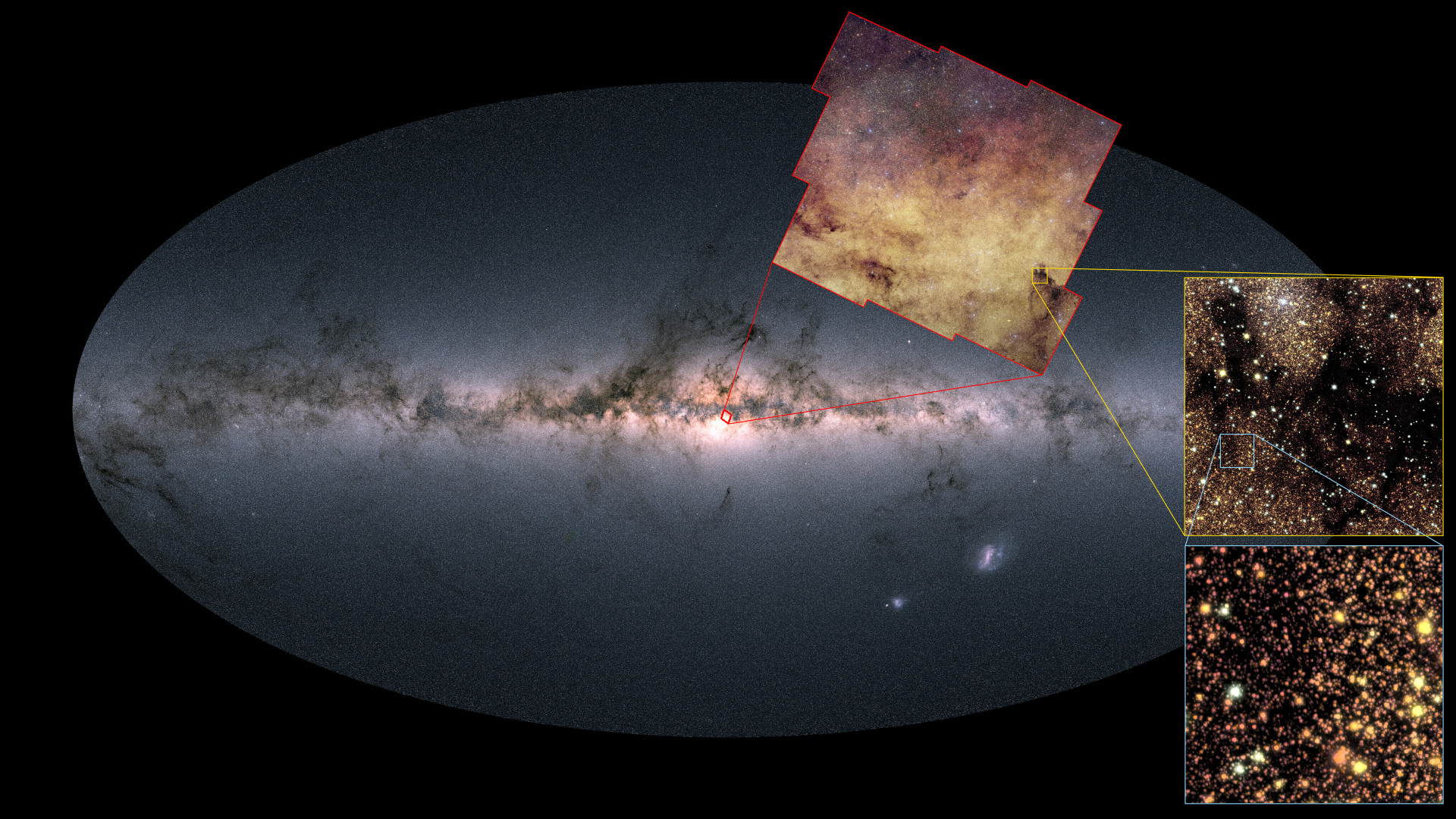
Researchers at The University of Manchester have played a key role in a new scientific release from the European Space Agency’s Euclid mission, unveiling the most detailed photo ever made of our Milky Way galaxy’s centre in visible light.
The image, which contains more than 60 million stars, offers scientists an unprecedented view of the galactic bulge – the dense, bright heart of our Galaxy – and could help researchers confirm the existence of any exoplanet found in this region and measure their mass.
The new data comes from the Euclid Galactic Bulge Survey, a dedicated observing programme designed to support the discovery and study of exoplanets using a technique known as microlensing.
Captured over around 26 hours on 23 March 2025, the Euclid space telescope covered nine neighbouring fields of view, with each pointing covering a patch of the sky larger than the full Moon. The result reveals a region of sky packed with stars, nebulas and star clusters in extraordinary detail.
Dr Eamonn Kerins, Astrophysicist at The University of Manchester, said: “Opening Euclid’s eyes towards the centre of our Galaxy was a very exciting moment for the team. It was the culmination of years of preparation and simulations to ensure Euclid could observe such a crowded region of the sky successfully, and without impacting on Euclid’s main science goals. The view Euclid gives us of the Galactic Centre region is absolutely stunning.”
The new observations show how Euclid’s capabilities can also be used for a broad range of astrophysics.