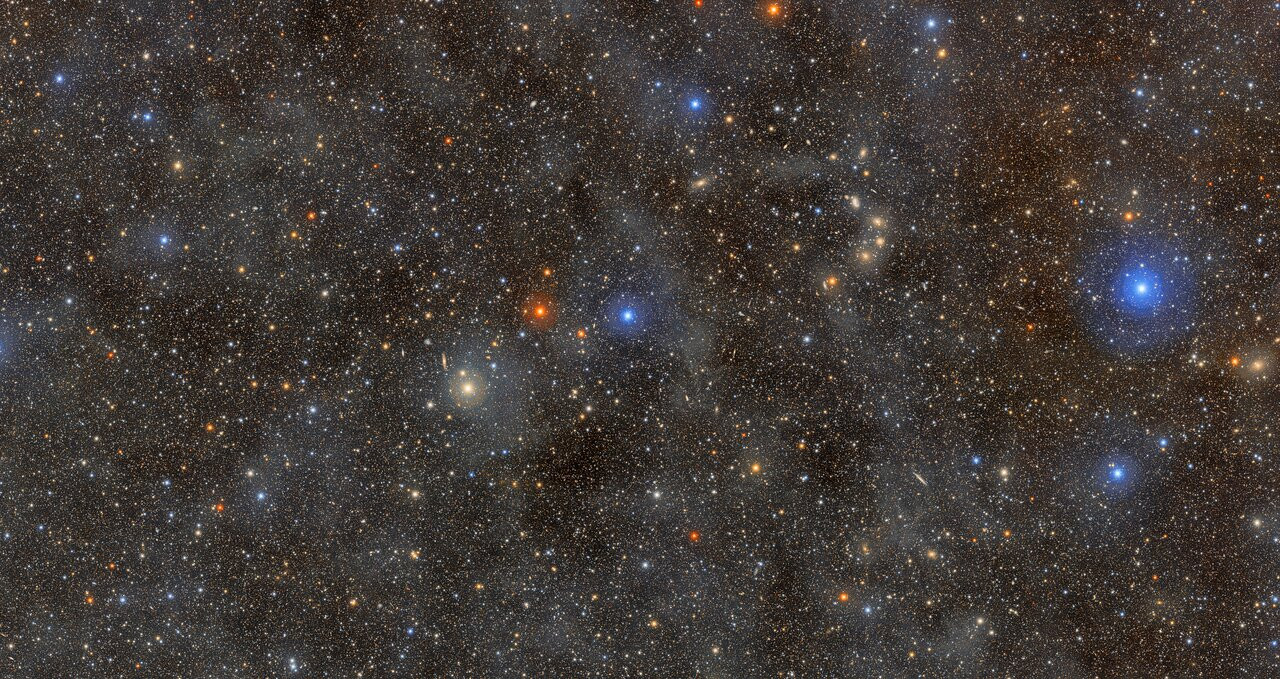
Manchester astronomers are celebrating the launch of the Rubin Legacy Survey of Space and Time (LSST) which began last week from a mountaintop in Chile.
After more than a decade of preparations, it’s the start of one of the most ambitious studies of the cosmos ever undertaken. For the next ten years, the LSST will capture the entire southern sky to create an ultra-wide, ultra-high-definition time-lapse record of our Universe. This movie will help solve some of the Universe’s biggest mysteries – such as the nature of dark energy, and the evolution of the solar system, Milky Way, and galaxies across cosmic time.
The University of Manchester is part of the LSST Consortium, a partnership of 36 institutions representing the UK’s leading astronomy research groups. Supported by investment from the Science and Technology Facilities Council(STFC),
Scientists at Manchester will use Rubin data to study the first galaxies and the evolution of the universe and its cosmological parameters.
“
“Rubin will revolutionise all areas of astronomy as it will allow us to not only explore the dark energy that drives the universe’s expansion, but also the variable or transient universe that has not yet been explore in any detail.
“At Manchester, we will use this data to study the very first galaxies in conjunction with other telescopes we are leading work in. Rubin is a continuation of the revolution and golden age in optical and near-infrared astronomy we are experiencing at the moment with many discoveries just waiting to be found.”
Christopher Conselice, Professor of Extragalactic Astronomy at The University of Manchester
„
During its 10-year survey, Rubin will catalogue an estimated 17 billion stars, 20 billion galaxies, and millions of events that change in the sky – more objects than there are living people on earth. With the survey expected to create up to 500 petabytes of data in its lifetime, the UK is playing a significant role in the management and processing of this unprecedented dataset. The UK’s LSST data facility will process 25% of the data from Rubin, turning raw images of the sky into the calibrated data products with which astronomers can do science, and will operate a science platform capable of supporting analysis of those data products by 20% of the international LSST community.
The UK’s LSST computing facility also hosts the Lasair event broker, a sophisticated software system supporting the near-real-time analysis of the alerts that Rubin issues whenever it detects a moving or time-varying celestial source. This alert stream – which can comprise millions of alerts per night and which includes a wide range of astrophysical objects, from nearby asteroids to distant supernovae – started flowing in February, ahead of today’s formal start of the 10-year LSST.
Professor Grahame Blair, Executive Director of Programmes at STFC, said: “Today marks the beginning of a new era in astronomy. Together with our partners, UK scientists, engineers and software experts, STFC is excited to be part of one of the most ambitious scientific projects ever undertaken. “The discoveries made over the next decade will inspire future generations, deepen our understanding of the cosmos, and reinforce the UK’s position at the forefront of astronomical research.”