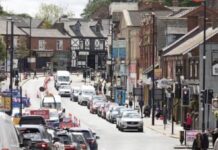

Oldham’s iconic Old Library has been J.R. Clynes Building honouring one of Oldham’s most important sons who became chairman of the Labour Party and home secretary under Ramsay MacDonald bt he would also cause controversy in the party, dropping his views on nationalisation and acknowledges that workers as well as employers bear responsibility for industrial unrest
About Manchester takes a look at his life and career
Clynes was born in Oldham, Lancashire on 27 March 1869, the son of an Irish farm worker who had been dispossessed during the Great Famine and come to England in search of work who was working as a gravedigger.
At age ten, Clynes went to work in a Dowry cotton mil in the town. He left school at twelve to work full time; thereafter he attended some night school classes but was largely self-taught.
A prodigious reader, he saved whatever he could from his wages to buy books. Shakespeare, Bacon, Milton and Ruskin were among his favourite authors. Clynes also earned extra money by acting as a reader for blind men, and it was one of these men who first introduced Clynes to political activism.
By the time he was sixteen Clynes had written several public letters and essays on the condition of child mill workers, and at seventeen he helped his fellow young workers set up a trades union to bargain for better wages and working conditions. In 1891 he quit the mill and joined the National Union of Gasworkers and General Labourers as an organiser. He married Mary Harper in 1893.
Clynes rose rapidly in prominence. In 1892 he was elected president of the Oldham Trades Council, and from 1894-1912 served as its secretary. He attend the first conference of the Independent Labour Party in 1893, and was also a delegate to the Zürich Socialist and Labour Congress that same year; one of his fellow delegates was Friedrich Engels.
Perhaps inspired by what he heard in Zürich, Clynes represented the Gasworkers Union at several trades union congresses in the later 1890s, arguing the case for workers to become more politically active. He was one of the founders of the Labour Representation Committee in 1899.
In 1904 Clynes was elected to the Committee’s national executive and, after the Committee became the Labour Party in 1906, was elected party chairman in 1908. In 1909 he travelled to Toronto to attend a conference of the American Federation of Labor. He became president of the Gasworkers Union, later the National Union of General and Municipal Workers, in 1912 and continued in that role until 1945.
In the general election of 1906, Clynes was one of twenty-nine Labour candidates to be elected, representing North-Eastern Manchester which later became Manchester Platting
He retained this seat until 1931. Clynes initially opposed Labour’s entry into the coalition government of 1915, but in 1917 he accepted a post on the Food Commission and became parliamentary under-secretary to the Food Controller, Lord Rhondda.
After the general election of 1918 Clynes was elected vice-chairman of the Labour Party, and in 1921 became chairman for a second time. Clynes led the Labour Party during the 1922 general election when the party won 57 seats;
He was though to be outmanoeuvred by Ramsay MacDonald in the contest for the chair of the parliamentary Labour Party, and became vice-chairman instead.
In January 1924, Clynes moved a no-confidence motion against the conservative government, leading to its collapse and replacement by a Labour minority. Ramsay MacDonald became Labour’s first Prime Minister, and made Clynes Deputy Leader of the House and Lord Privy Seal.
The minority government lasted less than a year, and Labour returned to opposition until the 1929 election, when Ramsay MacDonald once again became Prime Minister.
In 1929 when MacDonald became prime minister for the second time, Clynes was appointed as home secretary. He introduced several electoral reforms, championed prison reform, supported removal of the death penalty, and famously refused Leon Trotsky permission to settle in the UK.
After Ramsay MacDonald split from Labour in 1931 over an impending financial crisis, and formed a national government with the conservatives and liberals, Clynes accused him of “deplorable obscureness” and being “less a leader than a medium for collective opinions.” Clynes was asked to become Leader of the party for the second time, but declined the offer.
In 1931 Clynes lost his seat in the general election, but he was returned again for Manchester Platting in 1935 and held the seat until he retired in 1945. His wife was badly injured in an air raid during the Second World War. After the war, Clynes and his wife lived on his meagre union pension. He died in considerable poverty in Putney on 23 October 1949.