
Andy Burnham has called for an overhaul of the skills system to power future economic growth.
In a keynote speech at a conference on regional growth hosted by the Institute for Fiscal Studies and UCL Policy Lab, Greater Manchester’s Mayor unveiled a “concrete plan to reindustrialise the birthplace of the industrial revolution”, bringing high-value employment to all parts of the city region.
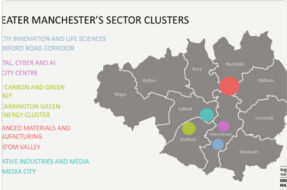
The plan he said will see Greater Manchester capitalise on established strengths like the creative industries, digital, and health innovation, while building out new spaces for advanced materials and manufacturing, and low carbon technologies – helping create new jobs across our towns and cities.
Greater Manchester has been the UK’s fastest growing city region since 2015, with annual growth and productivity outpacing the national average – and today’s speech comes as a new report, drawing on evidence from The Productivity Institute at the University of Manchester, sets out how the region’s economic plans can drive future growth.
The Mayor said: “Today Greater Manchester raises the bar on growth once again.
“We are publishing for the first time our cluster map: five defined locations across our city region which, as this century develops, will host industrial clusters of growing global significance.
“In other words, a concrete plan to reindustrialise the birthplace of the industrial revolution, bringing high-value employment to all parts of Greater Manchester.”
He credited the Government for the steps it has taken to give more powers to local areas – including its consultation on a new overnight visitor levy to help invest in new infrastructure and improve the visitor experience in Greater Manchester.
He also welcomed last week’s announcement on Northern Powerhouse Rail, as well as the opportunity for city regions to develop innovative new solutions to fund growth-maximising infrastructure, including business rates retention and land value capture.
But he also warned against potential blockers to growth – and made the case for more devolution of skills and technical education to create new opportunities for the next generation, and bring forward the high-skilled workforce that a reindustrialised Greater Manchester will need.
He said: “The logic of the cluster map I have set out today is that Greater Manchester’s skills needs will increasingly specialise in the next decade.
“The highly specific nature of the activities within our clusters means the employers will need a much more agile, integrated and responsive skills system than exists at present.
“We believe the city region should be able to move away from the fragmented approach of the past and have the ability to commission our skills system to deliver to the sectoral needs of our fast-changing economy.” and in a warning to central Government he added that the country was
“in a low growth doom loop” & “our shallow, adversarial political system has shown itself incapable of lifting us out of it and it only adds to the volatility, so we do find ourselves stuck in a rut and in hock to the bond markets”
Last November Greater Manchester Leaders approved £400 million of investment in the first wave of schemes delivering new housing and employment opportunities across our towns and cities.
These 17 schemes are set to deliver nearly 3,000 homes, more than 22,000 jobs, and 2 million square feet of employment space More projects are set to be considered in March.
These investments are based on sound economic thinking, looking at longer-term trends over the past decade, and identifying the places where pump-priming investment can deliver the biggest impact.